English| EUR
Suggested for you
More currencies
Choose a language
Water conditions at La Jolla Cove shift by the hour, driven by Pacific swells, seasonal upwelling, and tidal exchange through the submerged canyon that drops to 600 feet just offshore. This page reports today's snorkeling conditions—visibility range, surface chop, water temperature, and the narrow windows when kelp beds and garibaldi schools are clearest.
Quick answer
La jolla cove snorkeling conditions today depend on overnight swell direction and morning tide cycles. Visibility typically ranges from 10 to 30 feet, with clearest water between dawn and 10:00 when surge is minimal and sediment from the previous afternoon has settled. Water temperature hovers near 64°F in late September, requiring a wetsuit for comfort during extended submersion. Check the NOAA marine forecast before entering—southerly swells above four feet create strong backwash against the cove's rock walls.
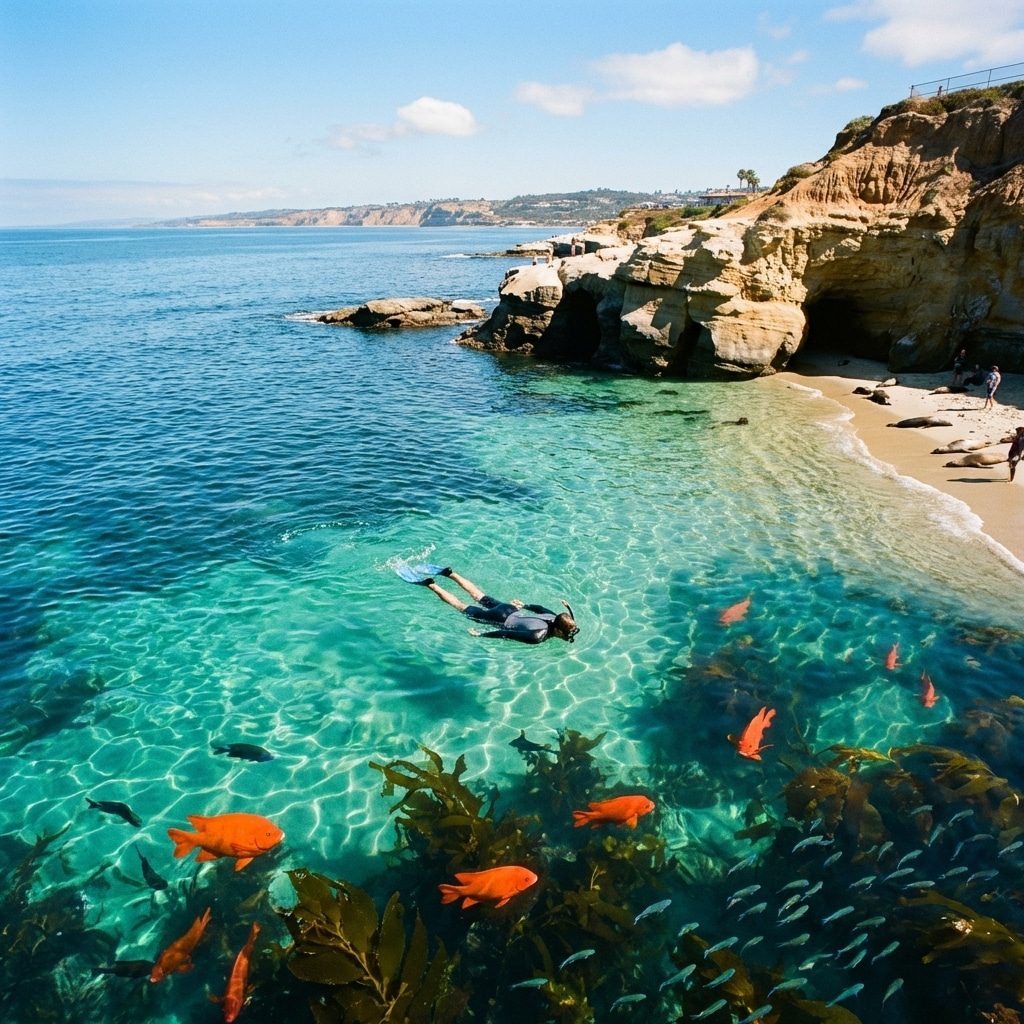
The kelp canopy at La Jolla Cove responds to subsurface currents that most snorkelers never see from shore. On calm mornings, giant kelp stands rise from 30-foot depths in near-vertical columns, their fronds fanning across the surface to create a golden lattice that filters sunlight into the water column below. By midday, when offshore winds pick up and boat traffic increases, particulate matter suspended by wave action reduces underwater visibility by half. The difference between a six-hour window matters more here than at sheltered bays farther north. Current la jolla cove snorkeling conditions reflect a seasonal transition. September marks the tail end of Southern California's warmest water temperatures before autumn upwelling pulls colder currents from depth. Thermoclines—sharp temperature boundaries between surface and deeper water—create visible distortion lines at 15 to 20 feet, where warmer water meets the canyon's cold outflow. Garibaldi, the official California state marine fish, patrol these thermal boundaries in schools of 20 or more, their neon-orange scales backlit by shafts of morning light that penetrate only during low-surge periods. The San Diego-La Jolla Underwater Park Ecological Reserve, which encompasses the cove, prohibits all fishing and collecting, making wildlife encounters predictable rather than random. Leopard sharks rest in sandy channels between kelp holdfasts during morning hours, undisturbed by snorkelers who maintain the reserve's mandatory five-foot distance. The reserve's boundaries extend 600 feet offshore and run 6,000 feet of coastline, but the richest snorkeling concentrates within 150 feet of the cove's eastern edge, where rocky reef structure creates habitat density. Entry requires timing. The cove's concrete steps become submerged during high tide, and exiting against incoming swells demands upper-body strength most casual swimmers overestimate. Lifeguards stationed at the beach year-round track la jolla cove snorkeling conditions today through handheld anemometers and visual surf checks every two hours, posting red flags when conditions exceed recreational safety thresholds.
“The kelp canopy responds to subsurface currents that most snorkelers never see from shore, transforming visibility within hours.”
The best window for snorkeling at La Jolla Cove is the early morning, specifically between 06:00–10:00, when ocean conditions are typically calmest and visibility is highest. Arriving during this time allows snorkelers to avoid afternoon winds and rising tide surges that can decrease water clarity.
Water 68–72°F
Warmest water temperatures provide comfortable conditions for extended snorkeling sessions.
Water 58–62°F
Cooler temperatures require thick wetsuits, but water clarity is often superior.
—
Minimal human activity creates calm water surfaces and reduced sediment disturbance.
Water 63–67°F
These periods offer a balance of moderate water temperatures and manageable crowd levels.
Verdict: For the clearest water and fewest crowds, plan your visit for a weekday morning in April or October during the best arrival window of 06:00–10:00.
La Jolla Cove is located at 1100 Coast Blvd, La Jolla, CA 92037. The most direct approach is by car or bus, though local street parking is limited.
Follow I-5 to La Jolla Village Drive, then head west toward the coast
Take MTS Route 30 to the La Jolla Blvd & Ravina St stop
From downtown La Jolla, walk west along Coast Blvd to reach the beach entrance
Plan your arrival for the 06:00–10:00 window to secure limited street parking and reach the beach before daily crowd peaks.
La Jolla Cove sits within a marine protected area where state and federal regulations prohibit take of any kind. Violations carry fines, and wildlife disturbance can trigger beach closures.
La Jolla Cove is accessible to the public every day of the week. The area remains open for visitor access throughout the day and night.
Everything you need to know about la jolla cove snorkeling conditions today
The la jolla cove snorkeling conditions today depend heavily on recent swell, tide levels, and wind patterns that influence water clarity. Checking local surf reports or visiting the official lifeguard site helps you assess whether the current environment is suitable for your water activities.
To gauge the la jolla cove snorkeling conditions today, visitors often monitor live webcams or consult regional oceanographic data for visibility updates. High tide usually provides better water transparency for observing kelp forest inhabitants.
There is 0 USD entrance fee as access to the beach and cove is free for all visitors. This allows everyone to enjoy the natural shoreline without purchasing a ticket.
To have the best experience, aim for an arrival window of 06:00–10:00. This practice helps you avoid peak crowds and secures limited parking near the coast.
Lifeguards are stationed to monitor beach safety and respond to emergencies in the designated swimming zones. They provide updates on ocean hazards that impact la jolla cove snorkeling conditions today.
Families frequently visit to explore the shallow waters, though children should always remain under adult supervision. The area serves as a protected ecological reserve, making it an educational spot for young swimmers.
The cove is part of a protected marine reserve, meaning all sea life is strictly off-limits and must not be touched or disturbed. Respecting these boundaries ensures the health of the habitat and keeps you compliant with local environmental laws.
The location is situated at 1100 Coast Blvd, La Jolla, CA 92037. You can use this address for navigation to the primary entrance.